
Neurodivergent Traits Quietly Shape Company Culture and Decision-Making
Biased labels have biased the research, and leaders are paying the price

The Bias in Labels
When arriving at a diagnosis, ADHD researchers mix observable outputs like fidgeting or having trouble staying seated with judgmental assessments like impulsive or emotionally intense.
When we call someone “impulsive,” we’re not just describing behavior. After decades of research, an ADHD disclosure at work brings that judgment into HR files and shapes research, policy, and leadership decisions.
Labels like impulsivity carry built-in bias. They’re not neutral, and that continued stigma also has downstream affects to the research as well as the behaviors of those around the diagnosed.
Interrupting others, blurting things out, making snap decisions. These are things we all do at times. Yet at some point, once an ADHD label is applied to your employee, impulsivity becomes a brand for life (Note, approximately 40% of ADHD cases are "inattentive-only" where impulsivity is not a prominent trait).
Sometimes it feels like the labels reflect some under-explored past discomfort with behavior that breaks norms—norms often built for predictability, not innovation.
Why Should Leaders Care
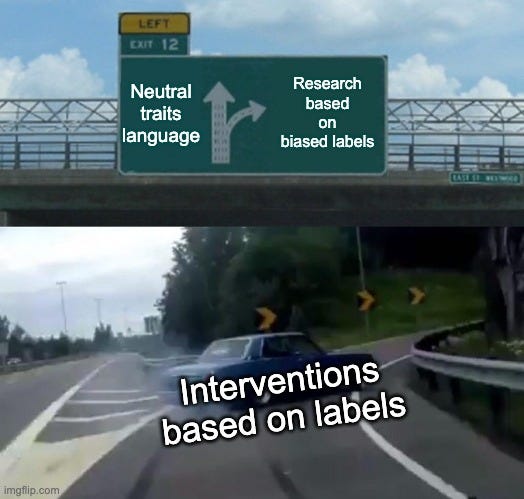
When clinical frameworks define fast decision-making as “impulsivity,” or energetic ideation as “hyperactivity,” we risk pathologizing what might be a strategic advantage.
If you want to lead neuroinclusive teams, consider if the the language you use has traces of bias.
For example, once something is labeled a deficit, then hiring, promotion, and coaching are working on overcoming or circumventing the deficit.
Clinical definitions of ADHD were built to detect difference, often through a lens of what's disruptive to school, work, or social norms. Yet what gets labeled as impulsive in an ADHD brain might be seen as decisive or visionary in a boardroom—or as spontaneous and fun in a social setting. The label hasn’t changed. The context and bias have.
Better labels → better decisions → better performance.
Is It Really Impulsivity?

Interrupting? Maybe it’s enthusiasm. Or racing thoughts trying to be shared before they disappear.
Blurting out in meetings? Might be a fast-moving brain struggling to match social pacing.
Snap decisions? Maybe this is intuition honed by pattern recognition, not recklessness. We may see this as people taking bold bets, but those bets may be based on a high volume of data not detected by the others in the board room who are still debating.
Everyone shows up at work differently. The labels we use are a window into our world; are we feeling discomfort with their behavior?
Is It Really Time Blindness?

One trait that gets challenged in my family these days is time blindness. Blindness is used colloquially as a deficiency, stemming from a lack of sight.
Instead of blindness, how about awareness.
When we can describe one’s ability to be conscious of the passage of time as high or low awareness, we are not judging them and we are also widening the audience to everyone. This is inclusive, unbiased language.
The other challenge with Time Blindness is the word Time. Anyone who has read the Jenny Odell's books knows that time is not just the 24 hour clock. The 24 hour day was created by the Ancient Egyptians who divided daylight into 12 sections with the sundial. Hours were not consistent. Yet we have arrived at a 60 minute hour, and a 60 second minute. We have built clocks that are not natural and require a special aptitude that has become increasingly important in our industrialized world. Having a high awareness of the 24 hour clocks also seems to correlate with a broader awareness of the passage of time within the structure of the Gregorian calendar.
So the challenge is not really about time blindness or even time awareness, but the way that our modern society structures time. For alternative trait names, we could consider Clock Awareness or Calendar Awareness.
What Comes Next?
I’m thinking deeply about how we can build more inclusive language at work, and there may be applications more broadly. If you have thoughts or ideas, or would like to suggest a term that should change because it creates bias or stigma, please comment below.
If this post resonates with you, let's connect! 👋 BrainTypes helps you bring these ideas into your workplace. Reach out to Shaun to explore how.